Christmas Grocery List KDP Interior: A Thoughtful Tool for Creators and Planners
Seasonal planning is no longer just about checking off tasks—it’s about intention, efficiency, and alignment with how people actually live and work today. The Christmas Grocery List KDP Interior reflects that shift. It’s not merely a blank list template; it’s a purpose-built, print-ready interior designed for creators building low- or no-content books on Amazon KDP. Its structure, formatting, and production quality respond directly to real-world needs: speed-to-market, consistency across variants, and reliability in printing—without requiring design expertise.
Why This Interior Fits Modern Creative Workflows
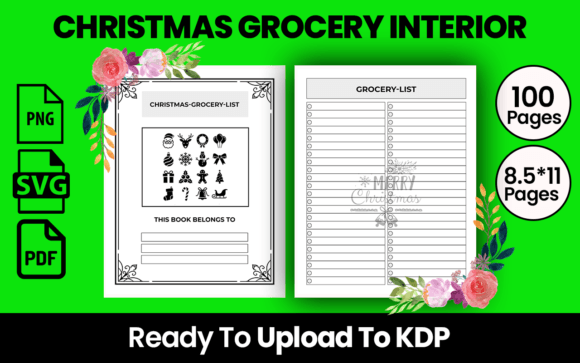
More creators than ever are entering the KDP space—not as full-time authors, but as solopreneurs testing niches, educators supplementing income, or marketers building brand-aligned tools. These users rarely have access to professional designers or prepress specialists. They need assets that work *immediately*: correctly sized, color-accurate, bleed-free, and tested on KDP’s platform. The Christmas Grocery List KDP Interior delivers exactly that. With trim size set to 8.5″ x 11″, CMYK color mode, 300 PPI resolution, and zero bleed, it eliminates common upload rejections and costly proofing rounds.
This isn’t theoretical convenience—it’s operational efficiency. For example, a freelance educator creating holiday-themed classroom resources can bundle this interior with a simple cover and publish within an hour. A small-batch stationery seller can use the included AI and PNG files to customize headers or add subtle branding before exporting fresh PDFs. Even someone launching their first KDP product benefits from knowing the interior has already passed KDP’s internal validation checks.
Three Page Counts, One Consistent Experience
The interior comes in three practical lengths: 100, 110, and 120 pages. That variation isn’t arbitrary—it reflects how users engage with seasonal planners. Some prefer lean, focused lists (100 pages offers ample space without overwhelming). Others build companion content—meal prep notes, gift tracking, or family recipe swaps—and benefit from the extra room in 110 or 120 pages. All variants share identical layout logic: clean typography, consistent margins, and logical spacing between list sections. That uniformity means buyers know what to expect across your catalog, and you maintain brand coherence even when offering multiple options.
Crucially, all page counts retain the same functional rhythm. Each two-page spread includes space for store names, categories (produce, dairy, pantry, beverages), item checkboxes, quantities, and notes—designed for handwriting clarity and quick scanning. No decorative clutter competes with usability. That balance of simplicity and structure is why this interior performs well in search: shoppers looking for “Christmas shopping list printable” or “holiday grocery planner KDP” find a solution that looks polished *and* works as intended.
File Flexibility Without Compromise
What sets this interior apart isn’t just its readiness—it’s its adaptability. You receive three PDFs (for direct upload), plus editable source files: a layered AI file (Adobe Illustrator) and high-resolution PNGs. That combination supports multiple workflows. Need to adjust a font for better readability? The AI file lets you do that cleanly. Want to preview how a logo would sit in the footer? Drop it into the PNG and test layouts fast. Prefer working in PowerPoint for quick edits? The PPT version gives you drag-and-drop control over elements like headers or section dividers—ideal for non-designers who still want visual control.
This flexibility matters because creators’ tools vary widely. Not everyone uses Adobe Creative Cloud. Some rely on Canva, others on Affinity Designer or free alternatives. By providing layered, export-ready assets—not just flattened PDFs—you reduce friction at every stage: editing, proofing, and repurposing. It also future-proofs your catalog. If you later expand into digital planners or Notion templates, those same design elements (icons, spacing rules, typography hierarchy) can carry over consistently.
Seasonal Demand Meets Evergreen Opportunity
Yes, “Christmas” signals seasonality—but the underlying need isn’t temporary. People plan holidays differently now. Fewer rely on paper flyers or last-minute store walks. More use lists to coordinate shared responsibilities (e.g., “Who’s bringing dessert?”), manage dietary restrictions across extended families, or align purchases with budget goals. Grocery planning has become a collaborative, values-driven act—whether that’s reducing food waste, supporting local vendors, or simplifying December logistics.
That’s why a well-designed Christmas Grocery List KDP Interior resonates beyond November and December. Educators use it in life skills units. Therapists incorporate it into executive function coaching. Small grocers offer it as a free download to build email lists. And creators repurpose the core layout for other occasions—back-to-school supply lists, Thanksgiving meal planners, or even wedding vendor trackers—because the underlying architecture scales.
Design Integrity That Builds Trust
“No content” doesn’t mean “no care.” In fact, the most successful low-content books succeed because they demonstrate quiet attention to detail: proper kerning, balanced white space, intuitive navigation cues, and tactile-friendly line weights for pen users. This interior meets those standards. Every checkbox is large enough for varied handwriting styles. Margins avoid the gutter where binding could obscure entries. Fonts are legible at small sizes yet retain warmth—not sterile, not overly whimsical.
That level of craft builds trust with buyers. When a customer opens a physical copy and finds crisp lines, consistent spacing, and thoughtful category groupings, they’re more likely to leave a positive review, explore your other titles, or recommend your work. It also supports long-term visibility: KDP’s algorithm favors titles with strong early engagement metrics, and usability directly influences completion rates and repeat purchases.
Practical Next Steps for Creators
If you’re evaluating whether this interior fits your goals, consider these realistic starting points:
- Start small. Upload the 100-page version with a clean, holiday-themed cover. Test pricing at $7.99–$9.99, which aligns with comparable planners while allowing room for promotions.
- Leverage the variants. Use the 110- and 120-page versions to create tiered offerings—e.g., “Basic List” vs. “Deluxe Edition with Meal Prep Notes”—without redesigning from scratch.
- Bundle intelligently. Pair this interior with a matching Christmas meal planner or gift tracker interior. Cross-link them in your book descriptions to increase average order value.
- Repurpose thoughtfully. Convert one page spread into a social media graphic (“Free Printable: Your First 5 Items for Holiday Shopping”) to drive traffic to your KDP page.
You don’t need a big team or big budgets to launch effectively. What you do need is reliable, tested infrastructure—like the Christmas Grocery List KDP Interior—that handles the technical heavy lifting so you can focus on what matters most: solving real problems for real people during a meaningful time of year.
If you appreciate products built with both precision and purpose—and designed to grow with your creative practice—you’ll likely find value in our expanding catalog. We release new interiors regularly, each tested on KDP and refined based on real creator feedback. No fluff. No guesswork. Just tools that help you ship confidently.