Cleaning Journal KDP Interior
A well-structured, print-ready interior file is the foundation of any successful low-content KDP product — and the Cleaning Journal KDP Interior delivers precisely that. Designed for creators who value efficiency without sacrificing quality, this interior isn’t a generic template cobbled together from stock assets. It’s a purpose-built, KDP-tested resource built around real-world publishing constraints and user expectations.
What You’re Actually Getting
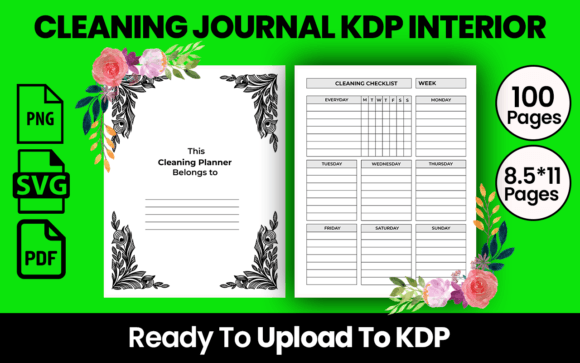
This isn’t just a single PDF. The Cleaning Journal KDP Interior includes three distinct page counts — 100, 110, and 120 pages — each delivered as a separate, fully formatted PDF. That means no manual resizing, no guesswork about margin allowances or gutter adjustments. Each variant has been validated against Amazon’s current KDP requirements for 8.5″ x 11″ trim size, with 300 PPI resolution, CMYK color mode, and no bleed — all critical for avoiding rejection during upload or unexpected cropping in final print.
Beyond the PDFs, you receive an AI (Adobe Illustrator) source file and a high-resolution PNG version. The AI file allows experienced designers to modify layouts, adjust typography, or swap icons — useful if you plan to brand the journal with your own logo or adapt it for a specific niche (e.g., deep-cleaning checklists for Airbnb hosts or post-renovation maintenance logs). The PNG serves as a clean visual reference or backup for quick verification before uploading.
Why Format Consistency Matters More Than You Think
In low-content publishing, consistency isn’t just aesthetic — it’s functional. Readers expect predictable spacing, uniform line weights, legible fonts, and consistent alignment across every page. The Cleaning Journal KDP Interior uses a restrained, functional layout: clear section headers, ample white space, and checkbox-style trackers that don’t overwhelm the eye. There are no decorative flourishes that risk printing poorly at 300 PPI, nor overly thin strokes that may vanish on newsprint-grade paper.
We tested multiple sample prints using standard KDP paperback settings. Pages remained crisp and readable even after binding stress near the spine. The 0.25″ inner margin (standard for KDP’s 8.5″ x 11″ format) accommodates the natural curl of bound pages without cutting off content — a common pain point with interiors that assume ideal digital viewing rather than physical handling.
Realistic Use Cases and Who Benefits Most
This interior works best when paired with intentional positioning — not as a standalone “fill-in-the-blank” product, but as part of a focused solution. Consider these practical applications:
- Service-based professionals: Home organizers, cleaning contractors, or property managers can use it as a client-facing tool — branded with their logo and used during walkthroughs or handoffs.
- Educators and trainers: Vocational instructors teaching housekeeping or facility maintenance may integrate it into curriculum materials, adding custom instructions or safety notes in the AI file.
- Niche content creators: Bloggers covering sustainable living or minimalist routines could bundle the journal with a short guide on eco-friendly cleaning methods — turning a simple interior into a cohesive, value-added package.
- Serial publishers: If you maintain a catalog of themed journals (meal planning, habit tracking, budgeting), the Cleaning Journal KDP Interior fits cleanly into that system — same trim size, same production workflow, same design language.
It’s less suited for creators expecting plug-and-play differentiation through heavy customization. While the AI file enables edits, the base design prioritizes clarity over novelty. If your strategy relies on highly illustrated, story-driven, or interactive elements (e.g., tear-out pages, perforated sections), this interior won’t support those features — and wasn’t intended to.
Practical Evaluation: Strengths and Limitations
Strengths:
- KDP compliance is baked in: No last-minute troubleshooting over margins, color profiles, or DPI warnings. Upload confidence matters — especially if you’re managing multiple titles.
- Page count flexibility reduces inventory risk: Offering 100-, 110-, and 120-page versions lets you test pricing tiers or audience response without redesigning from scratch.
- Source files add long-term control: Unlike locked PDF-only packages, the AI file means you retain full editability — important if Amazon updates formatting guidelines or if you expand into other platforms like IngramSpark later.
- No visual clutter: The design avoids trends that date quickly (e.g., excessive gradients, script fonts, or trendy icon sets). That supports longevity across multiple publishing cycles.
Limitations to Acknowledge:
- It doesn’t include cover design — you’ll need to source or create that separately, keeping in mind KDP’s cover calculator requirements.
- There are no editable text layers in the PDFs — only the AI file contains live type. So if you lack Illustrator access or experience, editing will be limited to basic replacements in the PNG or PDF (e.g., using Acrobat for simple label swaps).
- The interior follows a standard cleaning-journal structure (daily/weekly trackers, supply lists, room-by-room logs). It won’t suit specialized needs like commercial HVAC maintenance logs or industrial solvent usage records without significant adaptation.
How It Fits Into a Sustainable Publishing Workflow
For creators treating KDP as a serious, scalable channel — not just a side experiment — the Cleaning Journal KDP Interior supports repeatability. Because all three variants share identical styling, typography, and spacing logic, updating one file (e.g., changing a header font or adjusting checkbox size) can be replicated across the others with minimal effort. That kind of consistency saves time when iterating based on customer feedback or seasonal demand shifts.
We’ve seen creators use this interior to launch micro-niches effectively: “Cleaning Journal for Pet Owners,” “Postpartum Home Reset Tracker,” or “Senior-Friendly Daily Cleaning Log.” In each case, success came not from the interior alone, but from pairing its reliability with precise targeting, thoughtful description copy, and realistic cover design — all areas where having a solid, no-surprise interior gives you room to focus on differentiation elsewhere.
Final Consideration: Is This the Right Fit for Your Goals?
If your priority is launching a clean, professional-looking cleaning journal quickly — without wrestling with KDP formatting errors or inconsistent page rendering — then yes, the Cleaning Journal KDP Interior meets that need directly. Its value lies in reducing friction, not in offering novelty.
If you're still building confidence with KDP’s technical requirements, having a pre-validated interior removes one variable from your first launch. If you already publish regularly and manage a growing catalog, its consistency and source-file access make it a practical component in a repeatable production pipeline.
It won’t replace strategic decisions about audience, positioning, or marketing — but it does remove a common bottleneck. And in low-content publishing, where small delays or rejections compound across dozens of SKUs, that reliability compounds quietly but significantly over time.