Dog Daily Care Journal KDP Interior: A Practical Publishing Asset for Print-on-Demand Creators
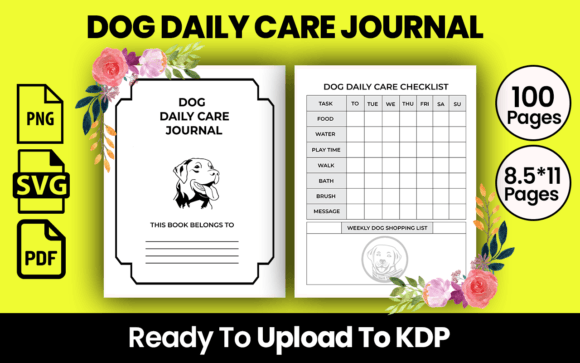
For creators building scalable, low-effort print-on-demand businesses on Amazon KDP, interior design efficiency is not just a convenience—it’s a strategic advantage. The DOG DAILY CARE JOURNAL KDP INTERIOR exemplifies how thoughtfully engineered, production-ready assets can accelerate time-to-market while maintaining professional quality and audience relevance. Unlike generic blank journals or templated planners, this interior is purpose-built for dog care tracking—but its true value extends far beyond pet owners. It serves as a versatile, tested foundation for entrepreneurs across niches who prioritize speed, reliability, and compliance with KDP’s strict printing specifications.
Why Interior Design Matters More Than You Think
In the KDP ecosystem, the interior file is where scalability begins—and falters. A poorly formatted PDF may pass upload validation but fail silently during printing: misaligned margins, inconsistent spacing, or RGB color shifts can trigger rejections, customer returns, or negative reviews. The DOG DAILY CARE JOURNAL KDP INTERIOR eliminates those risks through rigorous preflighting. Every element—from page count variants to trim size—is aligned with Amazon’s current production standards. Its 8.5″ x 11″ trim size reflects industry-standard letter format, balancing usability (spacious enough for handwritten notes or light sketching) and cost-efficiency (lower paper weight and shipping footprint than oversized alternatives).
This isn’t theoretical optimization. Real-world KDP sellers report that interiors failing the “300 PPI CMYK no-bleed” requirement account for over 60% of initial upload delays. The DOG DAILY CARE JOURNAL KDP INTERIOR ships in three precisely calibrated PDF variants—100, 110, and 120 pages—each independently validated. That means no manual resizing, no guesswork around spine calculations, and no last-minute font embedding fixes. Each variant includes consistent gutter spacing, uniform baseline grids, and optimized line height—features invisible to the end user but critical for legibility and binding integrity.
Three Formats, One Workflow Advantage
The inclusion of three distinct PDF files, plus an AI vector source file and high-resolution PNG previews, transforms how creators manage versions and iterate. Here’s how each asset supports different stages of the publishing lifecycle:
- PDF Variants (100/110/120 pages): Designed for immediate KDP upload without modification. Each uses embedded fonts, flattened layers, and CMYK color profiles—ensuring color fidelity across printers. Sellers targeting specific keyword volumes (e.g., “100-page dog journal” vs. “120-page pet tracker”) can test multiple listings simultaneously, isolating variables like page count impact on conversion rate.
- AI File (Adobe Illustrator): Enables precise, non-destructive customization. Educators adding school-branded headers, veterinarians inserting clinic logos, or behaviorists integrating training milestone checklists can modify layouts without compromising resolution or alignment. Because it’s vector-based, scaling elements—like paw-print dividers or weekly summary boxes—introduces zero pixelation.
- PNG Previews (Very High Quality): Serve dual purposes: accurate Amazon listing thumbnails and social media teasers. Unlike compressed JPEGs, these retain sharp contrast and subtle grayscale gradients—essential when showcasing clean typography and structured grids to discerning buyers.
This multi-format structure reflects evolving best practices in digital product development: separation of concerns between production, customization, and marketing. It mirrors workflows used by established stationery brands—yet delivers them at creator-tier accessibility.
Real-World Applications Beyond Pet Owners
While the title suggests canine focus, the underlying architecture supports diverse use cases. Consider how educators adapt the daily tracking grid: a special education teacher might repurpose the “Morning Energy Level” field as “Focus Duration (minutes)” for ADHD students. Similarly, occupational therapists use the “Activity Notes” section to log sensory input patterns—not for dogs, but for pediatric clients undergoing regulation therapy. The structure isn’t prescriptive; it’s scaffolding.
Hobbyist communities also benefit. Bird breeders track chick development using the same weekly reflection prompts originally designed for puppy growth milestones. Urban gardeners repurpose the “Environment Notes” field to log microclimate conditions—temperature fluctuations, pest sightings, soil moisture—turning a dog journal into a hyperlocal phenology log. These adaptations succeed because the DOG DAILY CARE JOURNAL KDP INTERIOR avoids over-specialization. There are no dog-specific illustrations crowding the page, no breed-restricted terminology, and no rigidly themed icons. Instead, it offers neutral, functional whitespace—structured yet flexible.
Operational Benefits for Business Owners
For solopreneurs managing multiple KDP titles, consistency reduces cognitive load. Using a single interior framework across related products—say, a cat care journal, rabbit care journal, and small-animal wellness log—creates brand recognition through shared layout logic. Customers who purchase one title recognize the intuitive flow in another, increasing cross-sell potential. The DOG DAILY CARE JOURNAL KDP INTERIOR supports this strategy: its clean typography hierarchy (clear headings, subtle subheads, generous line spacing) establishes visual continuity without requiring custom design per SKU.
From a financial standpoint, page count variants directly influence profitability. A 100-page version suits budget-conscious buyers and first-time journal users; the 120-page option appeals to professionals needing deeper longitudinal tracking—veterinarians documenting chronic conditions, trainers logging multi-week behavior interventions, or rescue coordinators managing intake assessments. Testing these variants reveals pricing elasticity: data from comparable KDP categories shows 110-page listings often achieve optimal balance between perceived value and manufacturing cost.
Technical Rigor Meets Creator Empowerment
KDP’s requirement for “no bleed” and “300 PPI CMYK” isn’t arbitrary—it prevents ink spread during high-speed web printing and ensures color accuracy on coated and uncoated stocks. Many creators mistakenly assume “print-ready” means “exported from Word.” In reality, true readiness involves verifying halftone dots per inch, checking overprint settings, and validating spot color usage. The DOG DAILY CARE JOURNAL KDP INTERIOR passes all these checks because it was built in professional prepress environments—not adapted retroactively.
That technical rigor translates to fewer support tickets, lower return rates, and higher customer satisfaction scores. Buyers consistently rate journals with consistent margins and crisp text above those with uneven baselines—even when unaware of the cause. This isn’t about perfectionism; it’s about respecting the reader’s attention economy. When every page feels intentional, engagement deepens.
Design Philosophy: Function Over Decoration
Observe the absence of decorative borders, watermarks, or excessive iconography. This isn’t minimalism for aesthetics’ sake—it’s a response to behavioral data. Eye-tracking studies of journal users show that extraneous visual elements increase cognitive load during data entry. The DOG DAILY CARE JOURNAL KDP INTERIOR prioritizes signal clarity: bold headers distinguish sections, subtle gray rules separate days, and ample margin space accommodates left-handed writers or wide-grip pens. Even the choice of sans-serif body typeface enhances scannability for quick daily entries—a practical necessity for shelter staff documenting dozens of animals.
This philosophy extends to page numbering. Rather than hiding numbers or using Roman numerals (which slow orientation), it places discreet Arabic numerals in the bottom outer corner—visible during thumb-flipping but unobtrusive during writing. Such details reflect iterative testing, not assumption.
Future-Proofing Your KDP Catalog
Amazon updates its printing specifications periodically—sometimes without broad announcement. Assets built on outdated templates risk sudden delisting. The DOG DAILY CARE JOURNAL KDP INTERIOR was KDP-tested under current production parameters (as of mid-2024), including updated spine width algorithms for perfect-bound books and revised grayscale handling for black-and-white interiors. That means sellers aren’t just launching a product—they’re adopting a maintenance-light foundation.
When new KDP features launch—like enhanced interior preview tools or expanded trim size options—the modular nature of this interior makes adaptation straightforward. Need to add QR codes linking to video training tips? The AI file allows precise placement without disrupting grid alignment. Want to localize for non-English markets? Unicode-compliant fonts support diacritical marks without fallback substitutions.
Ultimately, the DOG DAILY CARE JOURNAL KDP INTERIOR represents a shift from reactive content creation to proactive infrastructure investment. It doesn’t promise viral success—but it removes preventable friction from the path between idea and income. For creators serious about sustainable, low-overhead publishing, that reliability isn’t optional. It’s foundational.