Mazes Puzzles Book: A Strategic Tool for Clarity, Focus, and Structured Thinking
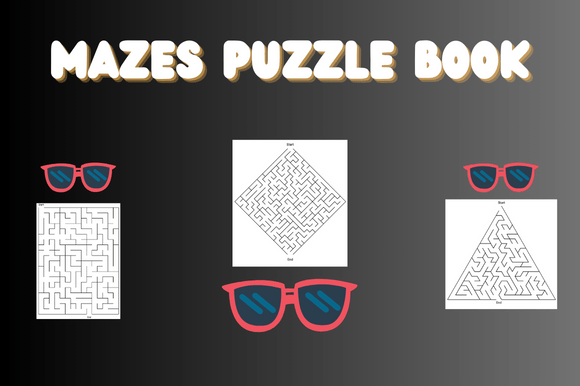
At first glance, the Mazes Puzzles Book—featuring 100 rectangle mazes, 100 diamond mazes, and 100 triangle mazes—may appear as a simple pastime. But for professionals who navigate complexity daily—entrepreneurs mapping growth paths, educators designing learning sequences, marketers structuring customer journeys, or product teams refining user flows—it functions as a tactile, low-stakes training ground for high-stakes thinking. Unlike digital tools that abstract decision logic into layers of dashboards and algorithms, this book offers direct, unmediated engagement with structure, constraint, and consequence.
Why Structure Matters More Than Ever
In an era of fragmented attention and reactive workflows, deliberate practice in navigating constraints builds cognitive resilience. Each maze in the Mazes Puzzles Book is a self-contained system: defined boundaries, one entry, one exit, and no ambiguity about success criteria. That simplicity is strategic. It mirrors real-world scenarios where goals are clear—but the path isn’t. Launching a new service line? You have a starting point (idea) and endpoint (revenue-generating launch), but dozens of interdependent decisions sit between them. Solving a diamond maze trains your brain to hold multiple directional options while maintaining forward momentum—without defaulting to the first visible route.
This isn’t about “brain training” in the vague sense. It’s about reinforcing pattern recognition under bounded conditions—a skill directly transferable to scoping projects, auditing customer touchpoints, or stress-testing operational assumptions. When you consistently choose *which turn to take* within strict geometric limits, you strengthen the neural pathways responsible for prioritization, trade-off evaluation, and anticipatory planning.
1. Pre-Meeting Calibration for Decision-Making Teams
Before a strategy session on pricing architecture or campaign sequencing, spend 7–10 minutes solving one rectangle maze from the Mazes Puzzles Book. Not as a warm-up exercise—but as a shared mental reset. Rectangle mazes emphasize linear progression with controlled branching. They prime participants to ask: *What’s the required sequence? Where can we parallelize? What’s non-negotiable before moving forward?* Teams report sharper alignment in early-stage discussions when they’ve just practiced navigating deterministic logic—not because mazes mimic business problems, but because they recalibrate attention toward step integrity and dependency awareness.
2. Visualizing Customer Journey Constraints
Diamond mazes—symmetrical, centered, with narrowing and widening corridors—mirror how user intent evolves across touchpoints. A prospect enters broad and curious (wide top), narrows focus during evaluation (centered bottleneck), then expands again toward action or advocacy (wide base). Using a diamond maze as a sketch layer, map actual customer behaviors onto its shape: Where do drop-offs cluster? Which “turns” represent friction points—like form fields or unclear CTAs? The geometry forces honesty about structural bottlenecks rather than blaming individual steps. It shifts analysis from “what happened?” to “what does the shape of this flow reveal about our design choices?”
3. Prototyping Communication Architecture
Triangle mazes begin at a single point and fan outward—ideal for modeling how a core message propagates across channels, audiences, or departments. Try assigning each branch to a stakeholder group (sales team, support agents, social media manager) and tracing how the original intent distorts—or strengthens—as it moves down the shape. This reveals misalignment in messaging discipline, timing gaps, or inconsistent framing. The Mazes Puzzles Book doesn’t solve those issues—but it surfaces them earlier, with less emotional charge than a post-mortem debrief.
How to Use the Mazes Puzzles Book Intentionally—Not Automatically
Randomly flipping pages and solving mazes won’t yield strategic value. Intentionality begins with purpose-setting. Before opening the book, ask:
- What decision am I preparing for? (e.g., reallocating Q3 marketing budget)
- What cognitive habit do I want to reinforce? (e.g., resisting premature optimization)
- What constraint am I currently underestimating? (e.g., bandwidth, approval cycles, data latency)
Then select the maze type deliberately:
- Rectangle mazes when sequence fidelity matters—product launches, compliance rollouts, or curriculum design.
- Diamond mazes when evaluating funnel efficiency, conversion bottlenecks, or resource allocation across phases.
- Triangle mazes when scaling communication, delegating execution, or managing message consistency across distributed teams.
Spend no more than 5 minutes per maze. Time pressure prevents overthinking—and mimics real-world decision velocity. If you get stuck, pause. Ask: *What assumption am I holding that’s blocking progress?* Then flip to the next maze. The goal isn’t completion—it’s calibration.
Risks of Misuse: When Mazes Become a Crutch
The Mazes Puzzles Book becomes counterproductive when used to avoid ambiguity rather than engage it. Some professionals treat maze-solving as a proxy for strategic work—mistaking the sensation of “making progress” for actual progress. Solving 50 triangle mazes won’t clarify your brand positioning if you haven’t defined your audience’s unmet need. Similarly, relying solely on geometric logic risks overlooking human variables: emotion, trust gaps, legacy systems, or unstated power dynamics.
Another risk is context collapse: applying maze-derived insights to situations where constraints aren’t fixed or knowable. A rectangle maze assumes stable walls; real markets shift mid-execution. Use the book to strengthen *how* you think—not to replace *what* you think about. Always pair maze practice with grounded reflection: *What changed in my understanding after this? What real-world variable isn’t represented here—and how will I account for it?*
Long-Term Value: Building Mental Infrastructure
Think of the Mazes Puzzles Book not as content, but as infrastructure—like maintaining a well-calibrated instrument. Just as a surgeon regularly practices sutures on models before operating, or a pilot runs emergency drills in simulators, consistent, low-stakes navigation practice builds durable mental reflexes. Over months, users report improved ability to:
- Identify false binaries in complex decisions (“either/or” thinking dissolves when you’ve traced three viable paths through a diamond maze)
- Communicate trade-offs with precision (“This is our bottleneck phase—the narrowest point in the diamond—so we’ll protect bandwidth here, even if it slows upstream activity”)
- Recognize when a problem is actually structural—not tactical (“We keep optimizing the wrong leg of the triangle because we’re ignoring the apex assumption”)
This isn’t about becoming faster at puzzles. It’s about developing a quieter internal compass—one that distinguishes between motion and direction, between activity and advancement.
Getting Started Without Over-Engineering
You don’t need a ritual. Keep the Mazes Puzzles Book within arm’s reach of your desk—not on a shelf. When you notice yourself ruminating without clarity, open to any page. Choose a maze type based on your immediate need: rectangle for sequencing, diamond for funnel analysis, triangle for message propagation. Solve once. Note one insight—not in a notebook, but mentally: *“I assumed the shortest path was best. It wasn’t.”* Or *“I retraced steps instead of backtracking cleanly—what’s my equivalent of that in this project?”*
That’s the leverage point. Not volume. Not speed. Not mastery. It’s the habit of asking better questions—before the pressure mounts, before the deadline looms, before the meeting starts. The Mazes Puzzles Book works because it meets you where you are: not as a learner needing instruction, but as a practitioner needing calibration. And in a world where most tools demand more time, more integration, more setup—the simplicity of pen, paper, and intentional constraint remains quietly revolutionary.